Copilot vs Rocket Money
Which Is Better For Cutting Costs?

Rocket Money made its name by finding and cancelling your subscriptions for you. It's a great entry point for anyone who wants to stop bleeding money on stuff they forgot they signed up for.
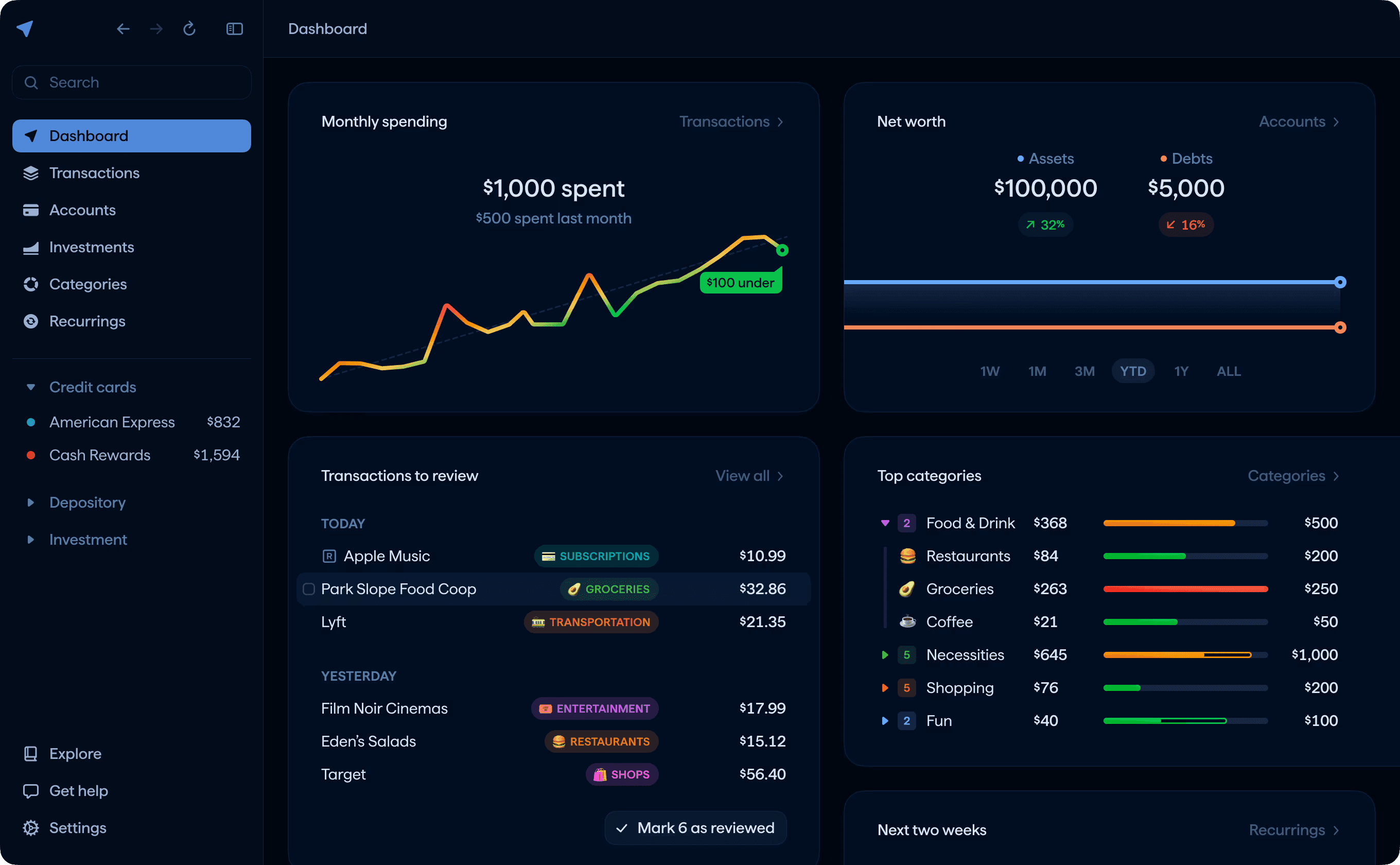
But once you've gotten off the ground, how do you keep your financial life going? This is where Copilot Money comes in. This all-in-one money app automatically categorizes every transaction and brings all your accounts, spending, and net worth into a connected view, so you're always seeing the bigger picture.
Both apps automate the busywork, but Rocket Money's automation stops at your bills and subscriptions. Copilot Money automates everything after that (spending, budgeting, net worth, investments, crypto, and real estate) so every part of your financial life is accounted for, not just your bills.
How are Copilot Money and Rocket Money Different?
If what you want is help finding and cutting costs, like someone to cancel the gym membership you forgot about or call your cable company for you, Rocket Money is built for exactly that. If you want your entire budget, spending, and net worth in one connected view, Copilot Money is the better fit. It still surfaces all your recurring charges and subscriptions, but also features real-time investment, crypto, and real estate tracking. With Copilot Money, you're not giving anything up to get the bigger picture.
Rocket Money is free to start, with a Premium tier that unlocks bill negotiation, hands-off subscription cancellation, and credit score tracking. That negotiation service comes with a catch worth knowing upfront: Rocket Money takes a success-based fee if it successfully lowers a bill. Copilot Money charges one transparent subscription price, and puts its attention toward giving you a complete, real-time view of your net worth, spending, and budgets. Copilot Money users are still likely to see cost savings right away. On average, Copilot Money finds $170 in forgotten recurring charges during onboarding, with no cut taken out of what you find.
Is Copilot Money or Rocket Money Easier To Use?
Both apps are built to reduce manual upkeep, just in different places. Rocket Money automatically flags recurring charges and, on the Premium tier only, will cancel or negotiate them for you. This saves time, but only on the bill-cutting side of your finances. Copilot Money's Intelligence engine automatically categorizes every transaction as it comes in and gets smarter the more you use it. This means your budget by category stays up to date without the manual maintenance.
Is Copilot Money or Rocket Money Better For Tracking Subscriptions?
Rocket Money lists your subscriptions in a simple feed so you know what's coming up, then leaves cancellation to their team if you go Premium. The view is a basic list of charges with little context for how they fit into your monthly spending.
Copilot Money takes your money tracking experience to a new level with award-winning design (Apple Design Award finalist, App Store Editor's Choice). The moment you connect your accounts, Copilot Intelligence surfaces every recurring charge automatically, laid out clearly alongside your spending and budget. Most Copilot Money users find over $170 in forgotten charges during onboarding.
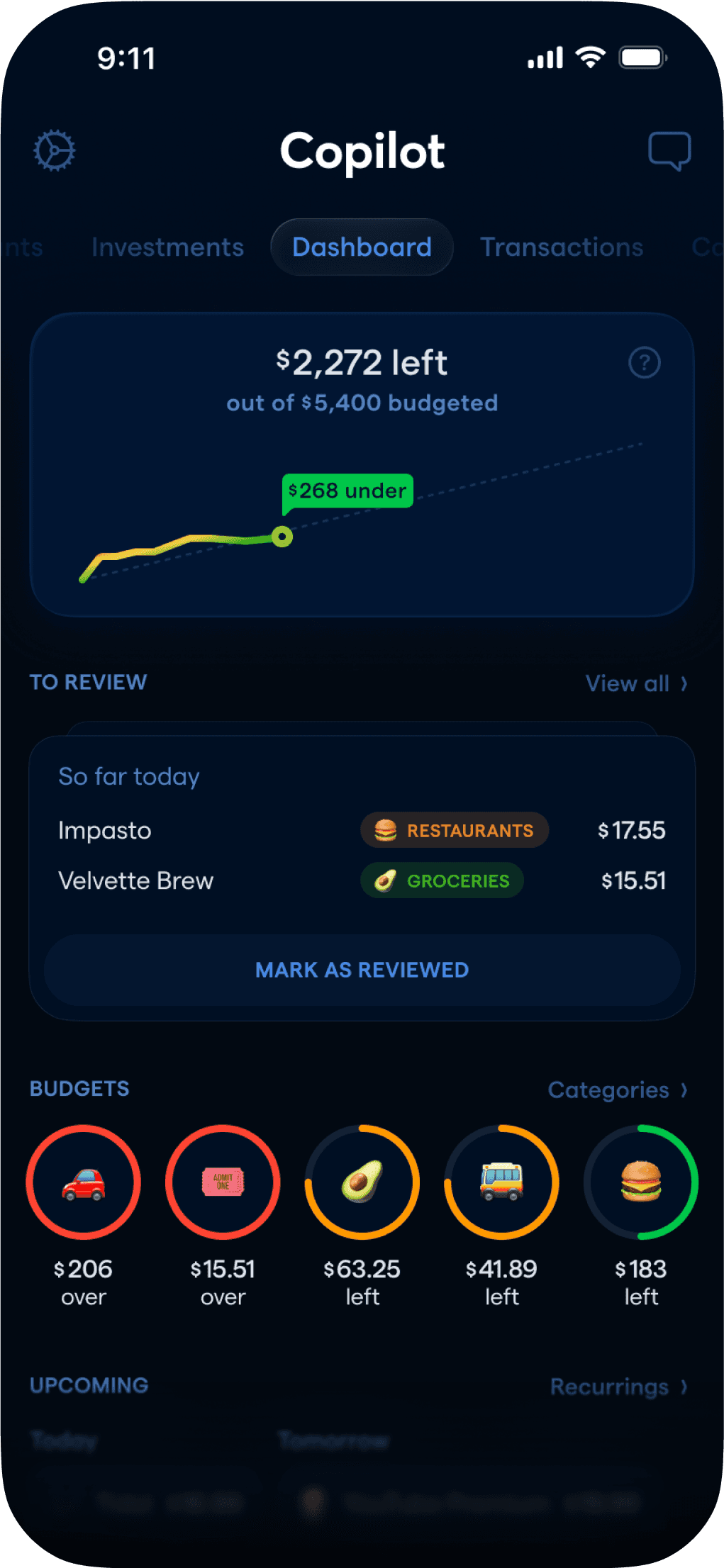
Every recurring transaction is also purposefully kept out of your Dashboard’s “left to spend” chart, so a big rent payment won't look like a spending spree. Instead, you get a clean, accurate picture of your monthly spend with recurring commitments accounted for on their own.
Is Copilot Money or Rocket Money Better For Long-Term Financial Planning?
Rocket Money links your checking, savings, investment, loan, and credit accounts and nets them against each other, with a live home-value estimate for real estate. It's a solid snapshot of where you stand today, but it isn't built to go deeper or track how you got there: there's no dedicated crypto tracking, investment detail is limited, and there's no running history to show your trajectory over time.
Copilot Money treats investment, crypto, and real estate tracking as core to the app, not an add-on. It tracks investment balances throughout the trading day, benchmarks your portfolio against the S&P 500, monitors crypto through connected wallets and blockchain addresses, and features a running net worth history in the Cash Flow tab.
Is Copilot Money or Rocket Money Better For Privacy?
Copilot Money is fully ad-free and stands alone, with no ad network or affiliated mortgage and loan business your data could feed into. Copilot Money never sells your financial data. Rocket Money's free tier runs on ads and its bill negotiation service means handing your account details to a team that contacts your providers directly on your behalf.
Is Copilot Money Only Available on Apple Devices?
Copilot Money was built natively for Apple platforms from day one, earning us a spot as an Apple Design Award’s finalist and is the only personal finance app to win an App Store Editor's Choice Award. Rocket Money's interface is built for broad, familiar simplicity rather than platform-specific craft.
Not on Apple hardware? Copilot Money on the Web has the same design and speed as our native apps. One honest note: Copilot Money doesn't currently have a dedicated Android app, while Rocket Money does. If a native Android app is a must-have today, we'd point you to our Web app in the meantime.
Should You Switch From Rocket Money to Copilot Money?
Rocket Money is for someone who wants a quick win: find the subscriptions, cancel the ones you forgot about, call it a day. Copilot Money is for someone who wants their whole financial life in one place instead of scattered across a subscription tracker, a separate net worth spreadsheet, and a budgeting app that doesn't talk to either. The same intelligence that flags a forgotten subscription also tracks your investments in real time, auto-categorizes your transactions, flags notable trends, and monitors your net worth. No ads, no cuts taken from what you find, and no handing your accounts to someone else's negotiation team.
A Rocket may get you off the ground, but a Copilot stays with you for the whole flight, helping you see exactly where you're headed.
FAQs
What's the main difference between Copilot Money and Rocket Money
Rocket Money focuses on finding and cutting costs by canceling subscriptions and negotiating bills for a success fee. Copilot Money focuses on giving you an automatically maintained, complete view of your money, including investments, crypto, and real estate alongside your everyday budget.
Does Rocket Money charge a fee to cancel subscriptions or negotiate bills?
Cancellation is included with a Premium subscription. Bill negotiation carries a separate success-based fee, commonly reported between 35% and 60% of your first year's savings.
Is Copilot Money more expensive than Rocket Money?
It depends on what you use. Rocket Money's free plan costs nothing but is ad-supported and limited; its Premium tier is pay-what-you-want between $7-14/month. Copilot Money is a flat $95/year, or $13/month, with no ads and no fee taken from any recurring bills it finds.
Is Copilot Money or Rocket Money better for investment and net worth tracking?
Copilot Money. Rocket Money's net worth feature is a snapshot but doesn't offer dedicated crypto tracking and has limited investment detail. Copilot Money tracks investments in real time, benchmarks your portfolio against the S&P 500, and monitors crypto through connected wallets.
Does Copilot Money have a free version like Rocket Money?
No. Copilot Money is a paid, ad-free subscription with a 30-day free trial. Rocket Money's free plan contains ads and is limited to basic subscription tracking, with more advanced features reserved for their paid Premium plan.
Can I try Copilot Money before connecting my accounts?
Yes. Copilot Money's Demo Mode lets you explore the full app with sample data. Rocket Money doesn't offer a demo mode.
Gain peace of mind
Welcome to Copilot Money, the money app that just works.